
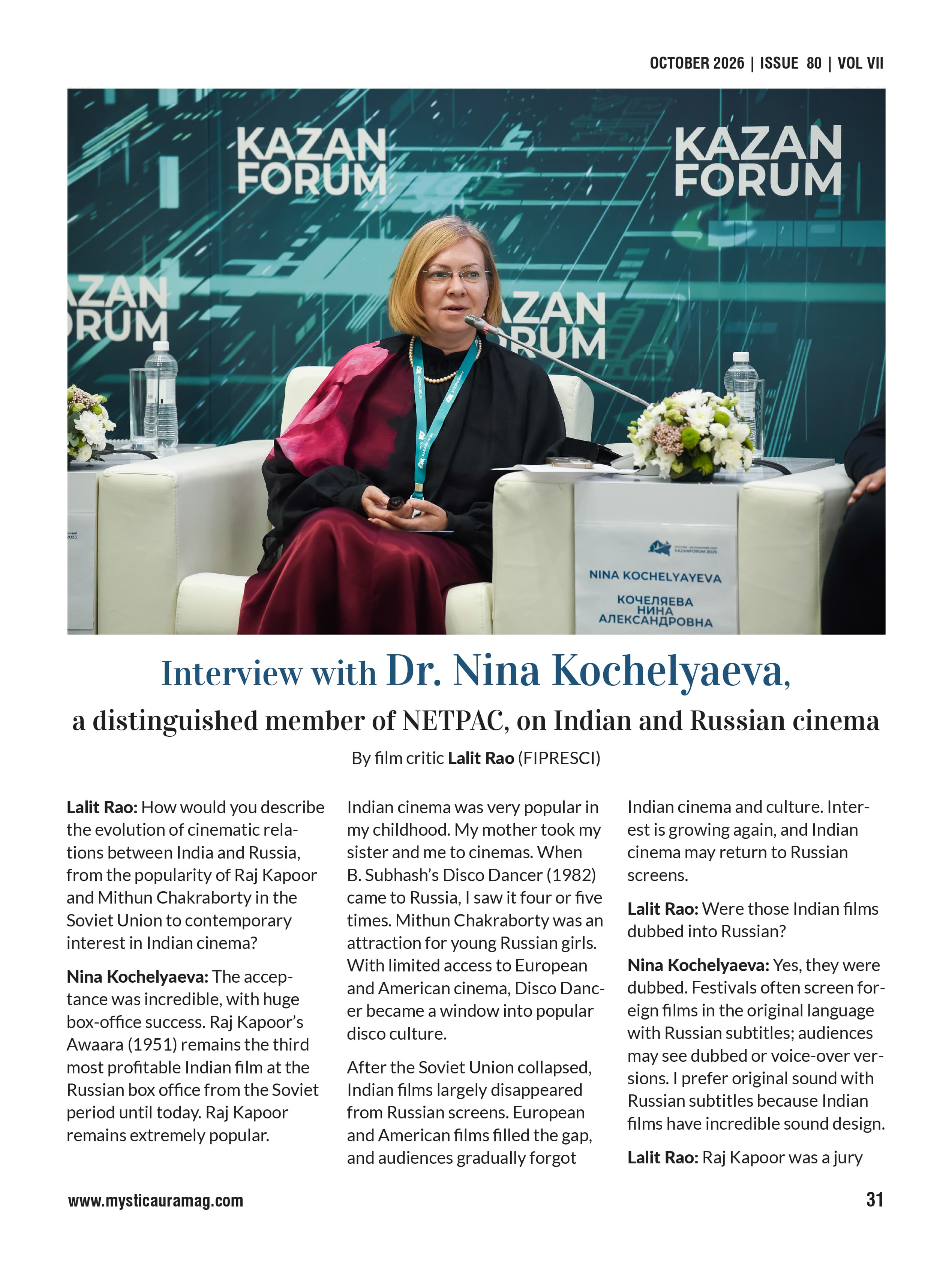
A distinguish member of NETPAC,on Indian and Russian cinema
DR .Nina Kochelyaeva
An exclusive interview by Lalit Rao
Lalit Rao: How would you describe the evolution of cinematic relations between India and Russia, from the popularity of Raj Kapoor and Mithun Chakraborty in the Soviet Union to contemporary interest in Indian cinema? Nina Kochelyaeva: The acceptance was incredible, with huge box-office success. Raj Kapoor’s Awaara (1951) remains the third most profitable Indian film at the Russian box office from the Soviet period until today. Raj Kapoor remains extremely popular. Indian cinema was very popular in my childhood. My mother took my sister and me to cinemas. When B. Subhash’s Disco Dancer (1982) came to Russia, I saw it four or five times. Mithun Chakraborty was an attraction for young Russian girls. With limited access to European and American cinema, Disco Dancer became a window into popular disco culture. After the Soviet Union collapsed, Indian films largely disappeared from Russian screens. European and American films filled the gap, and audiences gradually forgot Indian cinema and culture. Interest is growing again, and Indian cinema may return to Russian screens. Lalit Rao: Were those Indian films dubbed into Russian? **Nina Kochelyaeva: **Yes, they were dubbed. Festivals often screen foreign films in the original language with Russian subtitles; audiences may see dubbed or voice-over versions. I prefer original sound with Russian subtitles because Indian films have incredible sound design.
To read more kindly click on the PDF given and download your copy....
Interview
DR .Nina Kochelyaeva
A distinguish member of NETPAC,on Indian and Russian cinema